
Deepfakes – potential, risks and legal challenges
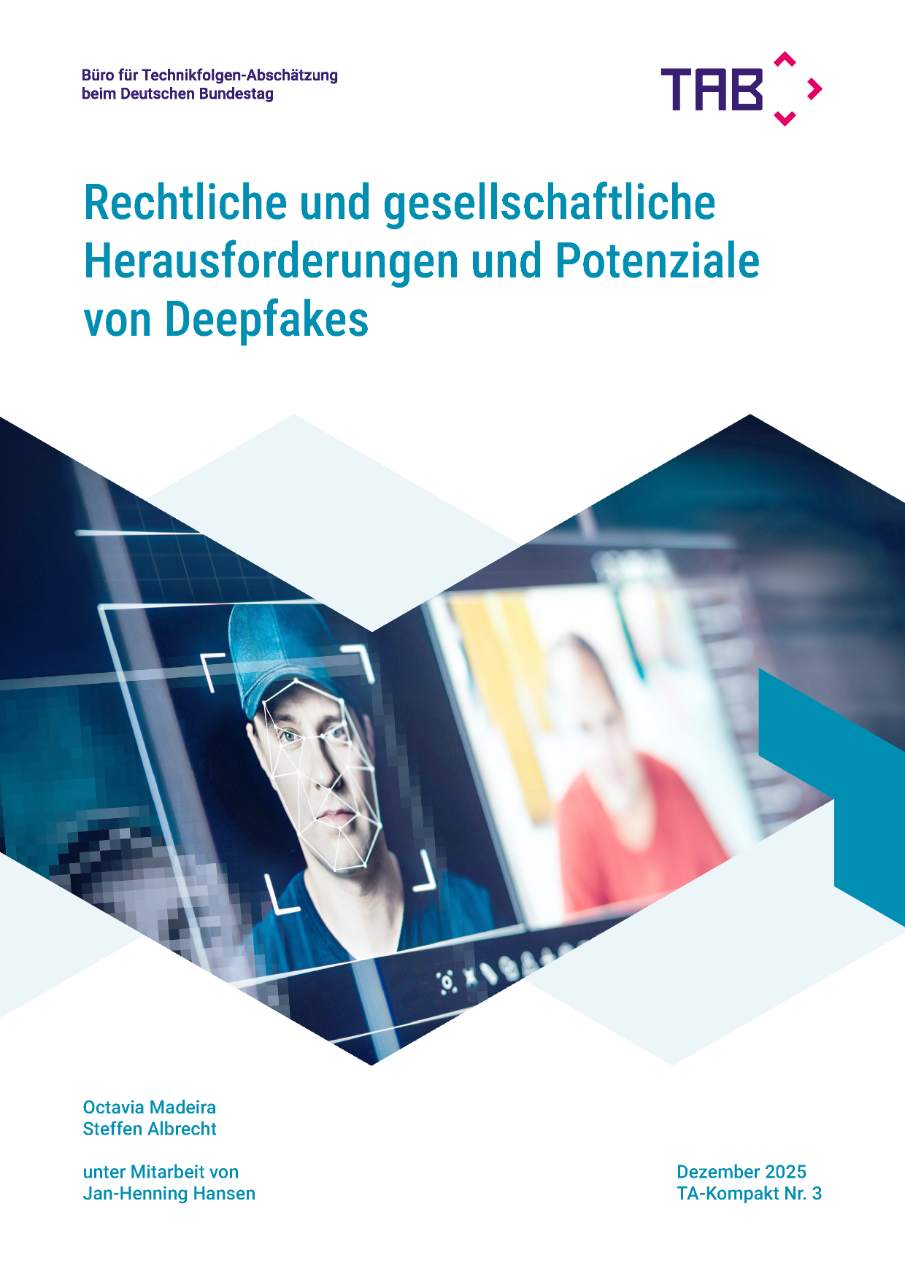
Deepfakes are AI-generated images as well as audio and video content content that falsely give the impression of authenticity. Since their emergence in 2017, the technologies used to create them have developed rapidly. While autoregressive models, autoencoders and Generative Adversarial Networks (GANs) have been important for some time, newer diffusion models can create high-quality forgeries even without extensive source material.
These technologies can be used for lip-synchronous translations in films and advertising clips, for educational purposes in museums, and to support law enforcement. However, considerable risks are associated with other applications, such as political disinformation, image-based sexual abuse and fraudulent identity manipulation, which pose a threat to society.
Currently, there is no explicit legal regulation of deepfakes in Germany. While many cases are covered by existing civil and criminal law, enforcement is often difficult, particularly with regard to sexualised deepfakes. A bill intending to supplement the German Criminal Code has been introduced by the Bundesrat in 2024. At an international level, special legal regulations exist for example in the USA and the UK, as well as framework laws such as the Deep Synthesis Regulation in China and the EU’s Digital Services and AI Act.
From a technological perspective, the further development of detection and verification methods is highlighted as an option for action. In Germany, for instance, such activities are being funded by the Federal Ministry of Research, Technology and Space, as well as the Federal Agency for Breakthrough Innovation (SPRIN–D). In addition to targeted legal adjustments, state and civil society measures to strengthen media and AI literacy are key action options. Other instruments for limiting the harmful use of deepfakes include voluntary commitments by political actors and media organisations, as well as interdisciplinary and international cooperation.
The central results are summarised in nine questions and answers, which are available online.
| The TA-Kompakt series provides the German Bundestag with concise information on current and controversial issues. |
02.03.2026
Download and further information
- TA-Kompakt Nr. 3 (only in German)
Rechtliche und gesellschaftliche Herausforderungen und Potenziale von Deepfakes (PDF),
Legal and societal challenges and potentials of deepfakes
doi: 10.5445/IR/1000190774 - Project page (with "Nine questions – nine answers")