
Plastic waste in the oceans: technological options for reducing it
Plastic waste in the oceans raises a global environmental and sustainability challenge. A significant proportion of plastics enters marine ecosystems via rivers, coastal areas or maritime activities, where it can persist for long periods of time and break down into microplastics. The consequences affect marine organisms and habitats and can also have an impact on food chains and human health.
Against this backdrop, the Office of Technology Assessment at the German Bundestag (TAB) examined which technical approaches can contribute to reducing plastic inputs and removing existing waste from water bodies in the study 'Technological options for reducing plastic waste in the oceans'. The results are now available as TA-Kompakt No. 4 and have also been published as Bundestag Printed Paper 21/3954.
First, the study provides an overview of the sources, pathways and distribution of plastic waste in water bodies and the oceans, as well as its ecological impacts. Building on this, it analyses various technological approaches for collecting or removing plastic waste in rivers, coastal areas and on the open sea. , The study examines the state of technical development, the effectiveness of the technologies and potential risks to habitats and organisms.
From a technology assessment perspective, it is clear that while technical solutions can help reduce marine litter, their effectiveness hinges heavily on conditions of use, monitoring, and integration into broader waste prevention strategies. Therefore, measures to prevent plastic waste at source remain a central component of sustainable strategies against marine pollution.
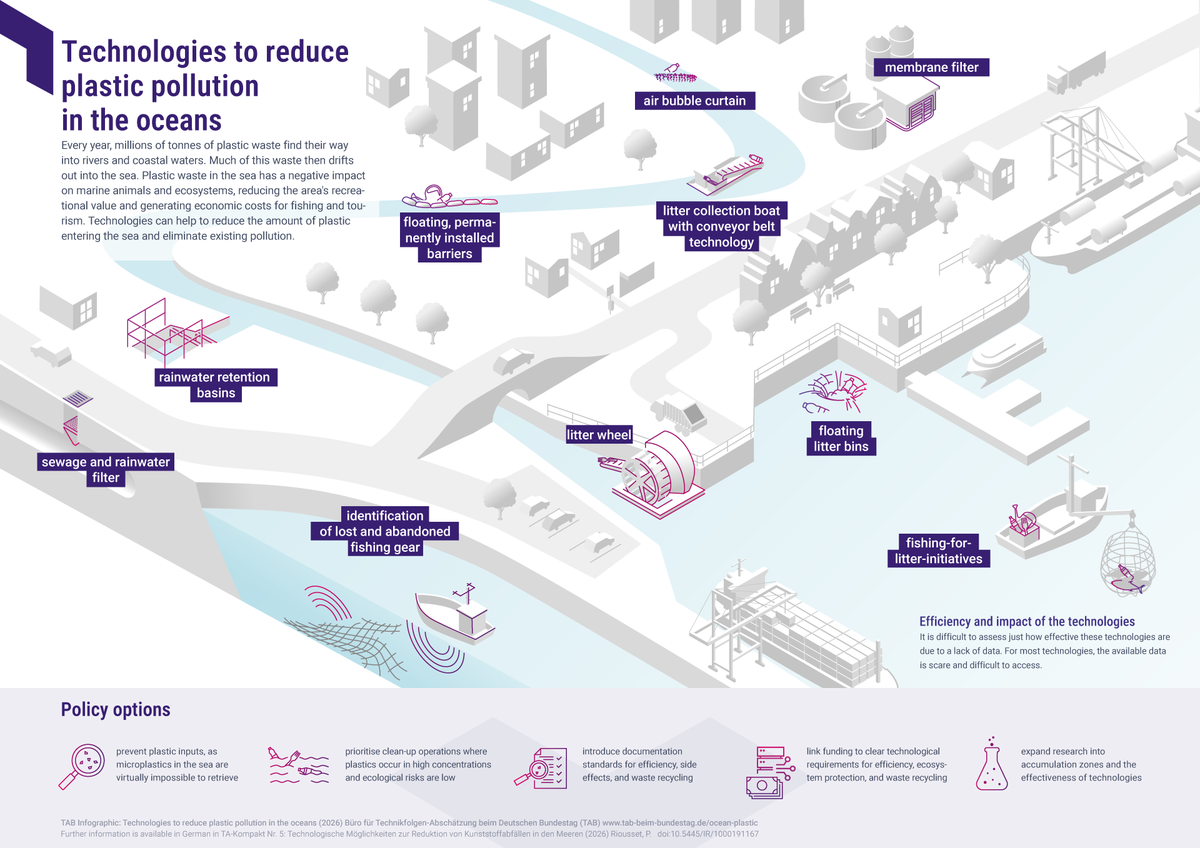
The study's key findings are summarised in 'Five Questions – Five Answers', available online on the project website and in TA-Kompakt. The key findings of the study are also summarised in ‘Five Questions – Five Answers’, which are available online on the project website. The infographic ‘Technologies to reduce plastic pollution in the oceans’ provides a clear overview.
| The TA-Kompakt series provides the German Bundestag with concise information on current and controversial issues. |
27.03.2026
Further information and download
- TA-Kompakt Nr. 5 (only in German)
Technologische Möglichkeiten zur Reduktion von Kunststoffabfällen in den Meeren (Technological options for reducing plastic waste in the oceans, PDF)
doi:10.5445/IR/1000191167 - TAB infographic: Technologies to reduce plastic pollution in the oceans (PDF)
- Project page (with "Five questions - five answers")