
New Resilience Dossier: cybersecurity in the research process
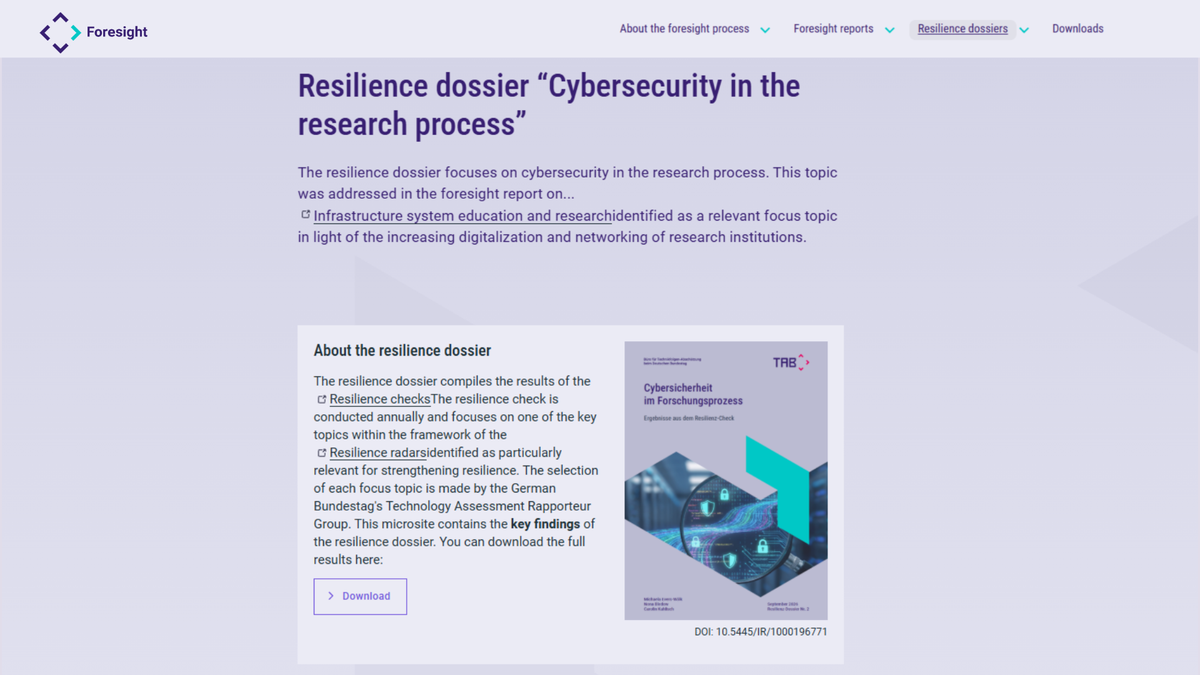
An effective research and innovation system depends on openness, academic freedom, international cooperation and the exchange of research data. At the same time, cyberattacks, scientific espionage, artificial intelligence and technological dependencies are putting increasing pressure on research institutions. Alternative future scenarios highlight possible development pathways, vulnerabilities and policy options up to 2030 and beyond.
While the full Resilience Dossier is currently available in German only, the accompanying microsite provides an English machine-translated overview of the key findings, future scenarios and policy options.
Three dimensions of cybersecurity in the research Process
The analysis examines three closely interlinked dimensions of cybersecurity in the research process:
- Protection and integrity of research data: How can the availability, confidentiality and integrity of research data be ensured in the face of growing cyber threats?
- Cybersecurity, skills and governance in research institutions: What technical, human, and organisational capabilities are required for effective cybersecurity in universities and research institutions?
- Digital sovereignty and trustworthy international cooperation: How can technological dependencies be reduced while maintaining openness and international research cooperation?
The analysis shows that cybersecurity in the research process extends far beyond technical protective measures. Its future development is shaped by the interplay of technological, societal, economic, political and legal factors. Therefore, in addition to resilient IT infrastructures, the skills, governance structures and available resources of research institutions play a central role.
What might cybersecurity in the research process look like in 2030 and beyond?
Alternative future scenarios for the 2030+ timeframe have been developed based on key influencing factors and their interactions. These scenarios illustrate different development paths and demonstrate the conditions under which the resilience of the research system could improve or deteriorate.
This highlights important trade-offs: security requirements must remain compatible with academic freedom, openness and international cooperation. However, dependence on a small number of external IT and cloud providers can lead to systemic vulnerabilities.
The scenarios are not forecasts. They serve to anticipate alternative developments, identify potential turning points at an early stage, and highlight the need for action by policymakers and the research system.
The analysis identifies several avenues for strengthening cybersecurity and resilience in the long term. These include the development of cybersecurity and management expertise, further development of governance and security structures, resilient digital infrastructures and measures to promote digital sovereignty.
The Resilience Dossier presents short-, medium- and long-term options for discussion.
The Resilience Check as an instrument of parliamentary Foresight
The Resilience Check serves as an instrument of parliamentary foresight. It enables TAB to examine selected future-oriented issues identified through the Resilience Radar in greater depth, focusing on those that are of particular importance for the long-term resilience and adaptability of societal systems.
The Resilience Dossier ‘Cybersecurity in the Research Process’ compiles the results of the 2025/26 Resilience Check and makes them available to policymakers, academics and the wider public.
September 15, 2026
Download and further Information
- Resilience Dossier No. 2
Cybersecurity in the Research Process (German-language PDF)
doi: 10.5445/IR/1000196771 -
Resilience dossier "Cybersecurity in the research process" on the microsite
Key findings, future scenarios and policy options
(English machine-translated version ) - TAB Foresight microsite
All Resilience Dossiers, Foresight Reports, and further information on the foresight process
(English machine-translated version)