
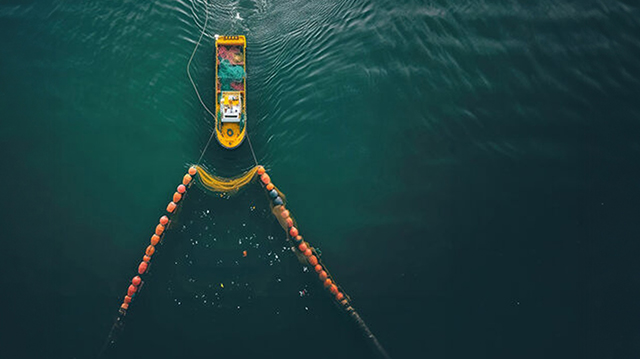
Technology options for reducing plastic waste in the oceans
- Project team:
- Thematic area:
- Topic initiative:
Comittee on Education, Research and Technology Assessment
- Analytical approach:
TA-Kompakt
- Startdate:
Oktober 2024
- Enddate:
2025
In a nutshell
Each year, millions of tonnes of plastic waste end up in rivers and coastal waters. Much of this makes its way out to sea. Plastic waste in the sea negatively impacts marine life and ecosystems, reducing the recreational value of the environment and incurring economic costs for the fishing and tourism industries. Technologies can help reduce the amount of plastic entering the sea and remove existing pollution.
This study provides an overview of current technologies for reducing plastic inputs into water and for removing existing waste from the sea, based on a brief summary of the current state of knowledge regarding the sources, pathways, dispersion, accumulation and degradation of plastic waste in the oceans.
From a technology assessment perspective, it is clear that while technical solutions can help reduce marine litter, their effectiveness depends heavily on framework conditions, monitoring, and integration into broader waste prevention strategies. Therefore, measures to prevent plastic waste at source remain a central component of sustainable strategies against marine pollution.
The study's key findings are summarised in 'Five Questions – Five Answers' and are available on this project page.
How does plastic waste accumulate in the sea?
- Plastic is found in all bodies of water around the globe.
- In the Global North, littering is the largest source of macroplastic, whereas in the Global South, the absence or malfunctioning of collection systems, combined with waste exports from the Global North, is the dominant source.
- In Germany, microplastic emissions are particularly driven by rainwater discharges and combined sewer overflows during heavy rainfall, which introduce substances such as tyre abrasion into bodies of water. Most plastics entering the water accumulate near the release points.
- Macroplastics in the sea can break down into microplastics through physical, chemical, and biological processes. Depending on the properties of the material and the environmental conditions, some of these particles may sink to the seabed, where they can remain for extended periods of time.
How dangerous is plastic waste for marine life and humans?
- Plastic waste in the sea affects all ecosystem services. The potential irreversible impacts of plastic pollution include geophysical effects, particularly changes to carbon and nutrient cycles.
- Plastics can harm marine life in various ways, such as through entanglement, injury and by inducing inflammatory responses, and thus present a threat to biodiversity and the natural environment.
- Plastic waste also incurs high economic costs for fisheries, aquaculture and tourism.
- The health impacts have not been sufficiently researched. However, evidence of negative effects on human health is mounting.
Which technologies can help reduce the amount of plastic in the sea?
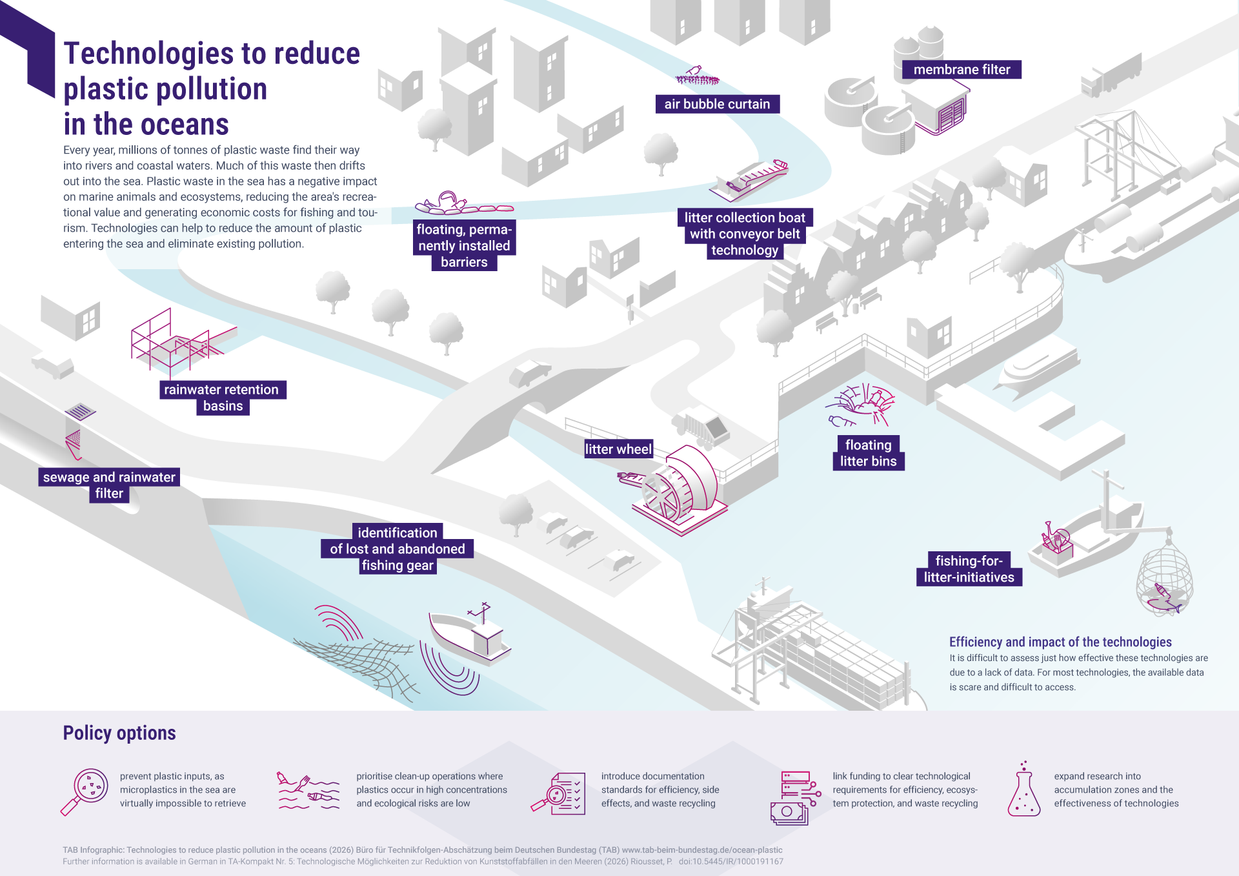
- The variety of existing technologies reflects the diversity of sources, waste sizes and areas of application.
- The largest share of technologies are mechanical solutions for removing floating macroplastics from the water’s surface.
- Stationary cleaning technologies enable targeted cleaning of accumulation sites, such as ports and river mouths. Mobile technologies are more flexible but generally consume more energy.
- Whereas prevention technologies have no direct impact on marine ecosystems due to their upstream placement, cleaning technologies that remove plastics from bodies of water can have an inadvertent negative impact on the local ecosystems.
- Current technology cannot effectively recover smaller microplastic particles that are already floating in the open sea or have sunk to the seabed.
- Data on the energy consumption of existing technologies and their impact on marine organisms is scare, and their effectiveness has not yet been sufficiently researched.
- A particular problem is the widespread lack of infrastructure for recycling or the environmentally sound disposal of waste in the Global South.
What political efforts are already underway to reduce the amount of plastic waste entering the oceans?
- Plastic emissions are extensively regulated within the EU. In recent years, new regulations have increasingly focused on preventing littering and microplastic emissions. Clean-up technologies have so far been the subject of very little regulation or standardisation.
- In order to reduce the cross-border impacts of plastic pollution, Germany is supporting international projects aimed at tackling marine litter and promoting clean seas.
- International clean-up measures are being discussed as part of negotiations on a global agreement to combat plastic pollution. Final decisions on this, as well as on a financial framework, are still pending.
Which policy instruments can ensure that relevant technologies are used effectively and in an environmentally sound manner?
- It is more cost-effective to prevent waste emissions than to remove them from the environment. In Germany, for example, heavily polluted sewage treatment plants, stormwater catchment systems, and combined sewer overflow facilities could be retrofitted with the necessary technology.
- If plastic emissions cannot be avoided, collecting them near the sources of emission helps reduce economic and environmental costs. When selecting measures and technologies, the conservation and social value of the affected accumulation zones, as well as the expected side effects, must be considered.
- To support decision-makers in investment decisions, an important step would be to introduce mandatory evaluation requirements during the development of clean-up technologies, using standards yet to be developed for documentation before and during deployment.
- The current funding measures for international projects to combat marine litter should be examined to establish whether they sufficiently cover technology transfer for clean-up technologies.
- Within the framework of international negotiations on an agreement to combat plastic pollution, Germany could continue to advocate for an international financial mechanism and help shape the funding conditions for projects.
Methodological approach
Methodologically, the study is based on a comprehensive review of measures for removing plastics from waterways, wastewater systems and rainwater systems. To establish a professional foundation, an initial expert report was commissioned to provide an overview of solutions already at an advanced stage of development. This was supplemented by a second brief expert report which compared the key findings with data from the MarLi-In and Plastic Pollution Prevention and Collection Technology Inventory portals, examined them in greater depth, and identified particularly promising new approaches.
Downloads
|
|
TA-Kompakt Nr. 5 (in German only) Technologische Möglichkeiten zur Reduktion von Kunststoffabfällen in den Meeren (PDF) The TAB report provides an overview of current technologies for reducing plastic inputs into water bodies and for removing existing waste from the sea and discusses options for action.
The TA-Kompakt series provides the German Bundestag with concise information on current and controversial issues. |
|
|
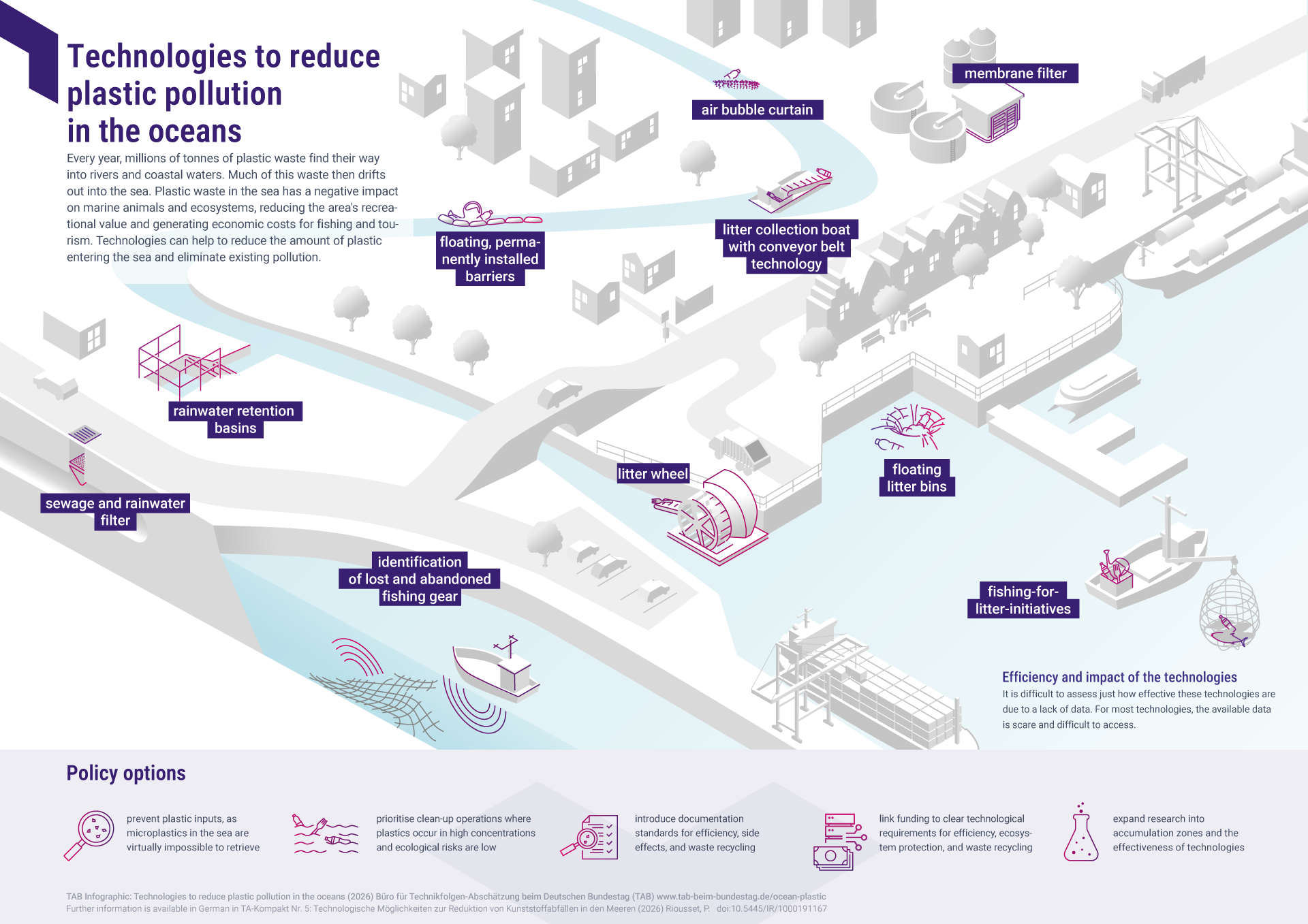
TAB Infographic Technologies to reduce plastic waste in the oceans (PDF) The infographic visualises the most important findings and policy options on one page |
In the Bundestag
The final report on the TA project was approved by the Committee on Research, Technology, Space and Technology Assessment on 28 January 2026, after which it was incorporated into parliamentary work.
Procedure – Report on the Parliament’s website (DIP)
Technikfolgenabschätzung (TA) Technologische Möglichkeiten zur Reduktion von Kunststoffabfällen in den Meeren
Projects investigating energy supply, resource use and the environmental impact of technology
More