
Digital twins: opportunities and challenges for climate-resilient urban development
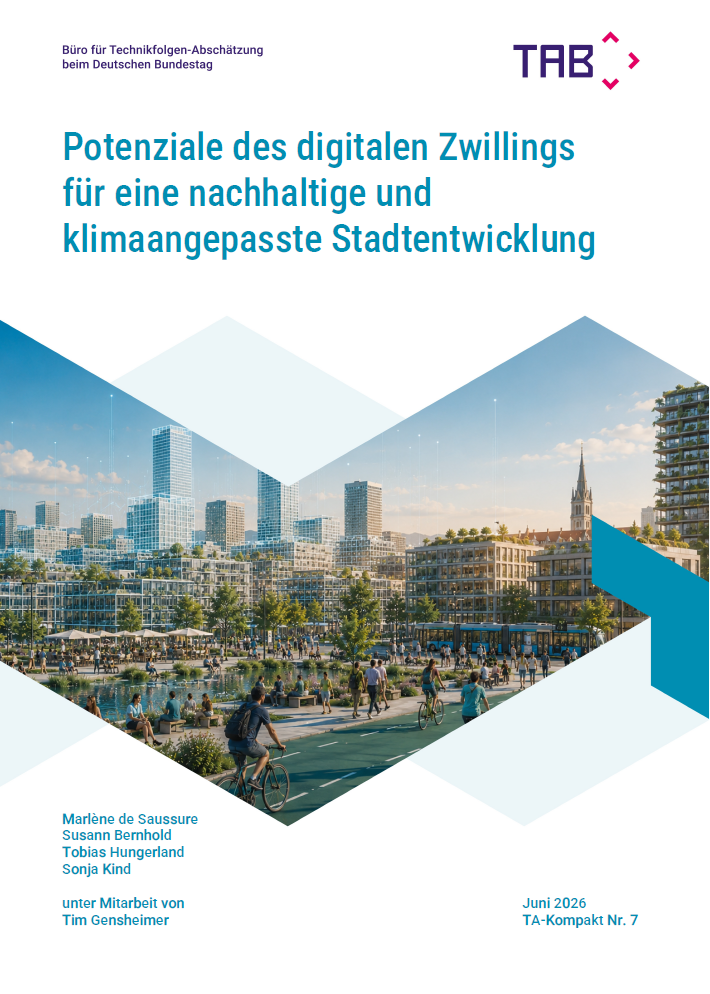
Urban digital twins — virtual, data-driven representations of urban systems — are becoming increasingly important for urban development, management, and climate adaptation. The new TAB study examines their potential, the barriers to their use, and design options.
Urban digital twins link physical infrastructure with digital models and continuous data flows. They integrate geodata, domain-specific data, and sensor data, enabling increasingly AI-supported simulations and forecasts. Applications range from the optimisation of energy and transportation systems and analyses of air quality to simulations of the interplay between extreme weather events and municipal infrastructure..
The study highlights a broad spectrum of potential applications. Urban digital twins can reduce emissions, improve resource efficiency, and streamline urban processes. They also open up new opportunities for transparency, citizen participation and data-driven decision-making in politics and administration.
However, significant challenges stand in the way. These include high demands on data availability, interoperability and computing power, as well as a lack of standards. Added to this are the high investment and operating costs, and in many cases, the lack of clear financing models — especially for smaller municipalities. The situation is further complicated by the fact that robust evidence of concrete benefits has often been lacking to date.
Against this backdrop, the study outlines three possible future scenarios, ranging from widespread use of urban digital twins, to fragmented individual solutions and their use in pilot and research projects. The development that materialises will depend largely on political, organisational, and technical framework conditions.
The study identifies clear data governance structures, a coordinating body, uniform standards and open data ecosystems as key prerequisites. Equally important are long-term financing approaches, appropriate methods for assessing costs and benefits, and transparent, ethically sound decision-making processes.
Overall, urban digital twins offer considerable potential for sustainable and climate-resilient urban development, but their implementation requires the coordinated interplay of technology, governance, financing and social acceptance.
The key findings are summarised in six questions and answers, available on the project website.
| The TA-Kompakt series presents current topics in a concise, scientifically sound format to support political decision-making processes in the German Bundestag. |
June 22, 2026
Further information and download
- TA-Kompakt Nr. 7 (only in German)
Potenziale des digitalen Zwillings für eine nachhaltige und klimaangepasste Stadtentwicklung (PDF)
(The potential of digital twins for sustainable and climate-resilient urban development)
doi:10.5445/IR/1000194201 - Project page (with “Six Questions – six Answers”)