
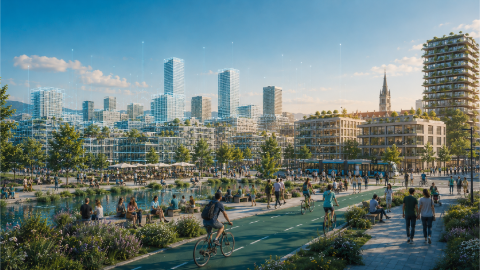
The potential of digital twins for sustainable and climate-resilient urban development
- Project team:
Marlène de Saussure (Project manager), Sonja Kind, Tobias Hungerland, Susann Bernhold
- Thematic area:
- Topic initiative:
Committee on Housing, Urban Development, Building and Local Government
- Analytical approach:
TA-Kompakt
- Startdate:
May 2025
- Enddate:
2026
In a nutshell
Urban digital twins (UDTs) are dynamic digital representations of urban environments and local government systems. UDTs combine geodata, Internet of Things (IoT) sensors and artificial intelligence (AI) to reduce emissions, use resources more efficiently, and engage citizens more closely in planning processes. However, their implementation is hindered by various obstacles, including a lack of scalability and interoperability, high investment and operating costs, and issues with data quality and protection. Based on 7 key factors, three realistic future scenarios for 2035 can be identified: (1) widespread, legally enshrined use of UDTs; (2) fragmented, isolated solutions with missed opportunities; and (3) reactive, rarely used UDTs. Concrete courses of action can then be derived, such as establishing clear governance structures, long-term financing models, uniform legal and standard frameworks, and ethical guidelines. UDTs can then be effectively, socially justly and sustainably integrated into urban development.
What are urban digital twins (UDTs), and what technical requirements are necessary for them?
- UDTs are defined as virtual, dynamically updated representations of urban and municipal systems that combine geodata and sector-specific technical information in a modular way.
- UDTs offer descriptive, diagnostic, predictive and simulation-based functions. They visualise complex interrelationships using 2D/3D maps, dashboards and AR/VR, and utilise artificial intelligence (AI) for pattern recognition, forecasting and semi-autonomous decision-making.
- The development of UDTs requires the integration of heterogeneous data (e.g. geodata, mobility, energy, climate and social infrastructure) from public and private sources.
What potential do UDTs offer for sustainable urban development?
- UDTs can create environmental, economic and social added value through reducing emissions, improving resource efficiency and enabling transparent public participation.
- By linking data and simulation tools, UDTs can contribute towards achieving the Sustainable Development Goals, particularly Goals 11 (sustainable cities and communities) and 13 (climate action), while also helping to achieve other environmental, social and economic goals.
What are the barriers to the development of UDTs?
- The scalability and technical performance of UDTs are currently limited by factors such as insufficient hardware and network infrastructure, complex data collection, transmission, processing and visualisation, and high resource and energy consumption.
- Fragmented data sources, differing data formats and a lack of standards complicate data exchange, integration and the bidirectional connectivity of UDTs.
- The high initial investment and ongoing operating and follow-up costs of UDTs, the uncertainty surrounding long-term funding, and the lack of quantified evidence of benefits so far present financial challenges, particularly for smaller local authorities with limited budgetary resources.
What framework conditions are conducive to the development of UDTs?
- Well-defined governance structures are essential to ensure data quality, interoperability, compliance with legal requirements and the effective use of UDTs in local government processes. In particular, a robust data governance framework is needed with defined roles and responsibilities, and a central coordinating body.
- Although various funding models and support programmes exist, such as public subsidies, public-private partnerships and EU and federal programmes, the necessary long-term funding for the establishment, operation and further development of UDTs is still inadequately supported.
- Clear and consistent legal frameworks for UDTs are required, including data protection and security requirements, liability and authorisation regulations, and binding standards and interoperability requirements.
- Ethical principles such as non-discrimination, barrier-free accessibility, transparent decision-making processes, responsible data handling and avoiding bias must be observed to ensure social justice and trust.
What might future development pathways for UDTs look like?
- Through a systematic analysis of 37 influencing factors, as well as a cross-impact analysis, this TA-Kompakt derives 7 key factors for the future development of UDTs. Based on different projections, the study outlines three plausible scenarios for 2035.
- Scenario 1 describes a future in which UDTs are firmly established across all local authorities and required by law. They receive financial support, enabling data- and AI-supported planning processes to facilitate comprehensive climate adaptation and sustainability measures while actively promoting citizen participation and open data ecosystems.
- Scenario 2 outlines a possible future in which UDTs are used sporadically and in a fragmented manner in individual cities. Financial and institutional barriers lead to insufficient scaling up, resulting in missed opportunities for effective climate adaptation and sustainable urban development.
- Finally, Scenario 3 describes a future in which UDTs are scarcely used beyond individual pilot projects because funding is limited, political will is weak, and integration is poor. This leads to reactive, fragmented urban development in which climate risks are only addressed in isolated cases without long-term, data-driven measures.
What policy options can be derived from this, and what further research is required?
- In order to utilise UDTs comprehensively and effectively for climate-resilient and sustainable urban development, various technical, organisational, and political policy options must be integrated. These include the creation of a standardised system architecture, expansion of IoT sensor networks and scalable computing infrastructures, implementation of user-friendly interfaces, adherence to clear data governance, establishment of sustainable financing models, creation of a binding legal framework and design guided by ethical principles.
- Further research is needed into robust metrics for measuring and evaluating the actual added value, cost-effectiveness, societal impacts and long-term effectiveness of UDTs-based measures, and for systematically examining their integration into administrative and planning processes.
Methodological approach
The study combines qualitative and exploratory research methods. It is based on a systematic analysis of the current literature, as well as interviews with experts from urban development, local politics, technology development, research and planning. Building on this, seven key factors for the use of UDTs in the context of climate-adapted and sustainable urban development were identified using scenario analysis. Based on this, three possible future scenarios were developed. For methodological reasons, two of these were discussed in a focus group workshop with civil society representatives to gather their assessments, needs and reservations.
Download
|
|
TA-Kompakt Nr. 7 Potenziale des digitalen Zwillings für eine nachhaltige und klimaangepasste Stadtentwicklung (PDF) In the TA-Kompakt series presents current topics in a concise, scientifically sound format to support political decision-making processes in the German Bundestag. |
Im Bundestag
Der Abschlussbericht zum TA-Projekt wurde am 10. Juni 2026 vom Ausschuss für Forschung, Technologie, Raumfahrt und Technikfolgenabschätzung abgenommen und geht damit in die parlamentarische Arbeit ein.
Vorgang - Bericht auf dem Parlamentsserver (DIP)
Technikfolgenabschätzung (TA)
Potenziale des digitalen Zwillings für eine nachhaltige und klimaangepasste Stadtentwicklung (Link erfolgt nach Veröffentlichung)
Related TAB Publications (in German)
Further TAB analyses address key aspects of digitalisation, local infrastructure development and data-driven management, which are also relevant to the use of urban digital twins.
|
Themenkurzprofil Nr. 82 |
|
|
TAB-Kurzstudie Nr. 4 |
|
|
TAB-Arbeitsbericht Nr. 205 |
|
| TAB Report Nr. 198 Energy Consumption of ICT Infrastructure – Climate Impacts of Digital Infrastructures Examines the environmental impacts of the expansion of digital infrastructure and highlights conflicting objectives between digitalisation and climate protection. doi.org/10.5445/IR/1000151164 |
|
|
TAB Report Nr. 204 |
|
|
TAB-Arbeitsbericht Nr. 201 |
|
|
TAB-Kurzstudie Nr. 3 |