
Biotechnology and artificial intelligence: Risks posed by research to security and biological weapons proliferation
- Project team:
- Thematic area:
Biotechnology und health, Digital society and economy, Infrastructures and security
- Topic initiative:
Defence Committee
- Analytical approach:
TA project
- Startdate:
September 2024
- Enddate:
2026
Security risks and policy options at the intersection of AI and biotechnology
At a Glance
- The potential of AI for biotechnology has sparked a new security debate. The debate focuses on the risks posed by the possible development of biological weapons, particularly by non-state actors and individuals without specialist knowledge.
- However, it is not possible to reliably assess how this might change in the future, which is why continuous monitoring of these highly dynamic developments is essential.
- Given the potential variety of malicious actors and biological threats with extreme consequences, further precautionary measures to minimise risk at various levels should be considered now.
- The available evidence does not conclusively answer the question of whether AI models could substantially lower the barriers to developing biological weapons. For individuals with little or no specialist knowledge, empirical data currently suggest this is unlikely.
sprungmarken_marker_5209
What is involved
Rapid advances in the analysis and synthesis of genetic material (DNA), as well as in the targeted modification of genes, have greatly simplified and expanded the possibilities for researching, modifying, or redesigning biological processes in organisms over the last 10 to 15 years. Computer-aided analysis and design processes are becoming an increasingly important tool in this context. These capabilities have not only accelerated basic research, such as the elucidation of gene and molecular functions and the causes of disease, but have also spurred revolutionary developments in fields such as industrial biotechnology and the development of new medicines and treatment options.
The concept of synthetic biology (also known as 'engineering biology'), whereby biological systems can be modified or redesigned with increasing ease and specificity, emerged at the beginning of the 2000s. From the outset, the scientific — and, to a certain extent, societal — debate has focused on potential health and environmental risks (biosafety), as well as risks arising from misuse (biosecurity).
With the ever-increasing possibilities of synthetic biology brought about by AI and its interaction with biotechnological methods (AIxBio), these discussions have intensified in recent years. A new security debate has emerged that focuses heavily on the potential development of biological weapons (see box). There are concerns that these new capabilities could significantly lower barriers to bioweapons and facilitate the generation of more dangerous or novel biological agents. Furthermore, concerns have been raised that the effectiveness of biosecurity and defence measures could be reduced or undermined.
Potential risks posed by AIxBio: Concerns, available evidence and uncertainties
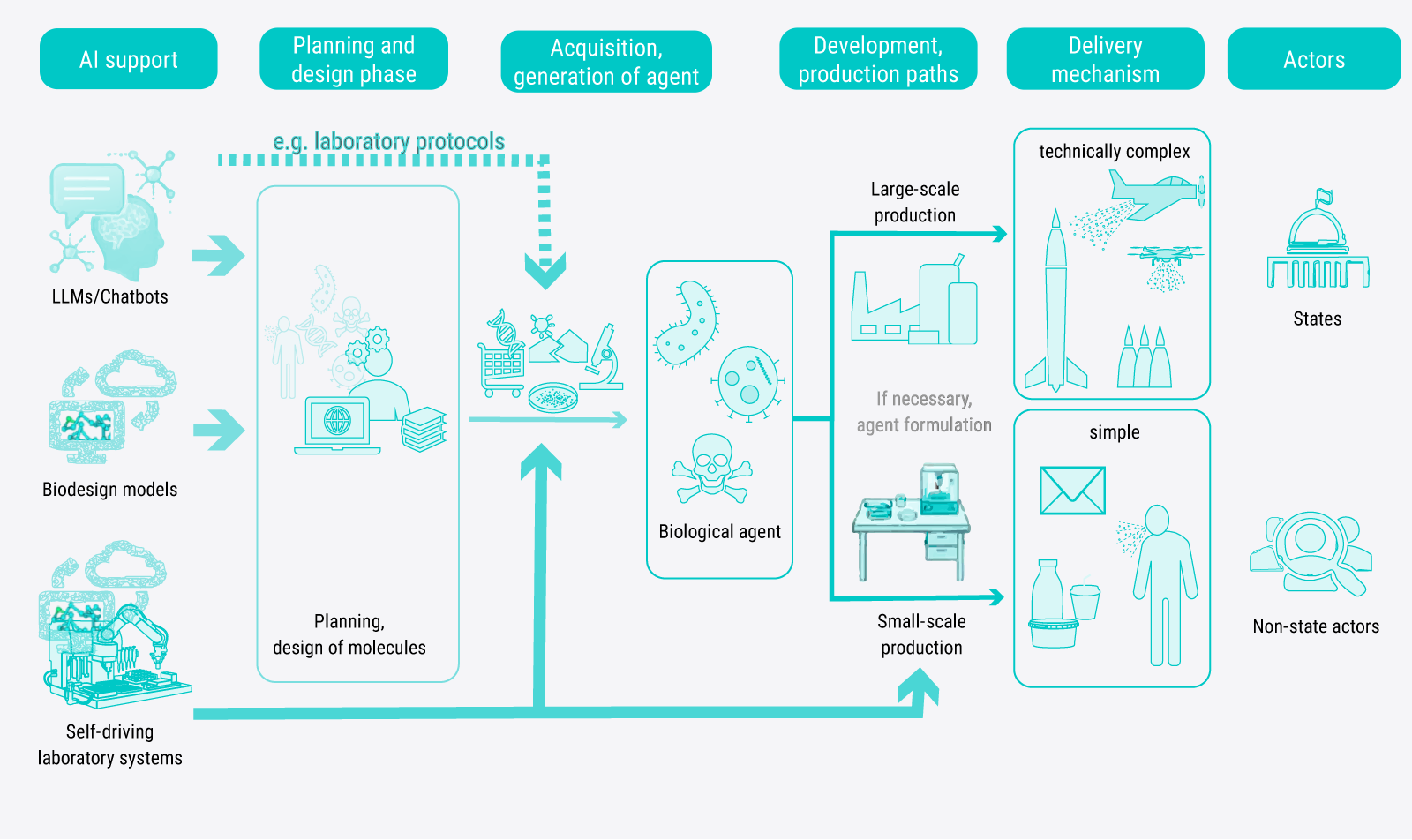
Concerns about biosecurity risks are primarily based on three developments:
- the potential acquisition and dissemination of knowledge through large language models (LLMs);
- the potential design of modified proteins, toxins and new pathogens using biological AI models; and
- the combination of AI systems with robotised laboratory platforms to enable experiments or development and optimisation cycles to be carried out automatically, or even 'autonomously'
(See Figure 2):
Biological weapons (Bioweapons)
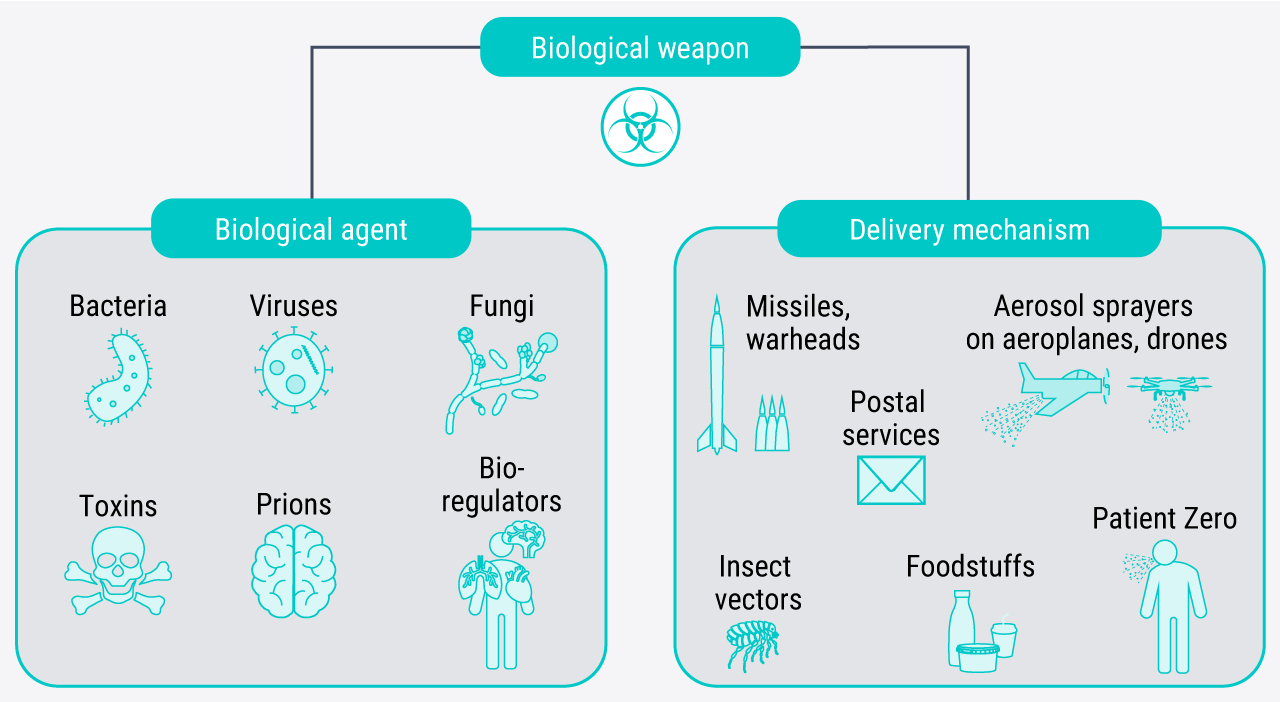
Bioweapons disseminate pathogens or toxins and typically consist of a biological agent and a delivery mechanism. The development of bioweapons requires specific knowledge and technical capabilities, particularly for weapon systems designed for large-scale dissemination or with a long range. For example, such knowledge is required for the handling of pathogens, their formulation, or large-scale production. However, bioweapons can also be less technically complex, for example when the dissemination of small quantities of agents is sufficient and can be achieved using simple, non-technical mechanisms (see Fig. 1).
The only large-scale military use of bioweapons took place between 1939 and 1942, when Japan used them in China, resulting in what is believed to be thousands of deaths. Bioterrorist attacks have so far been relatively rare. Only a few of these have resulted in illness or death. For instance, in 1984, members of the Rajneesh sect contaminated food in restaurants in the USA with salmonella, causing hundreds of people to fall seriously ill. A series of attacks involving letters containing anthrax spores in the USA in 2001 led to at least five deaths and several further cases of illness.
Legally, the possession of bioweapons is prohibited, and their use is outlawed under international law. The primary basis for this is provided by international treaties relating to bioweapons and their use. The most important of these is the 1972 Convention on the Prohibition of Biological Weapons, also known as the Biological Weapons Convention (BWC).
Empirical studies leave open the question of the extent to which LLMs can assist bioterrorists.
Although tests (benchmarks) of LLMs regarding knowledge and capabilities relevant to the development of biological weapons suggest that various newer LLMs sometimes significantly exceed the benchmark values set by human experts, studies involving test subjects designed to determine the extent to which LLMs can enhance individuals’ knowledge or skills beyond conventional internet searches (so-called 'uplift' and 'red-teaming' studies) do not present a consistent picture. However, a recent study suggests that the coordinated use of several LLMs can significantly improve the performance of Bachelor’s Degree students with little or no biology background when answering various biological knowledge or technique questions and tasks, sometimes bringing their performance close to or beyond expert level. The practical relevance of these findings in the real world remains unclear, though. Consequently, studies involving test subjects in biology laboratories ('wet labs') have begun. An initial large-scale study suggests that LLMs (from mid-2025) are no more effective than traditional internet tools at helping undergraduate students with little or no biology or laboratory experience to carry out basic tasks to produce a relatively simple virus in a laboratory. It remains to be seen to what extent newer LLMs or the additional use of biology-specific LLMs might change this and what performance improvements might look like for more experienced individuals (e.g. PhD students in biology). Further studies of this kind are likely to be required.
Biodesign models could facilitate the undetected production of dangerous genetic sequences.
AI-based protein design models enable the creation or redesign of complex protein structures. In principle, therefore, novel and potentially dangerous proteins or (protein) toxins could also be designed. However, their functionality would likely need to be verified or optimised through laboratory experiments that are both research-intensive and resource-heavy. It has already been demonstrated that protein toxins can be redesigned in such a way that they presumably remain functional, and that, due to differences in their gene sequence compared to the original version, they can circumvent current methods for securtiy checks for nucleic acid synthesis. Nevertheless, the actual extent of the risk remains unclear. Experimental data suggest that protein versions redesigned in this way (using current open-source models) lose their function, particularly larger proteins and enzymes.
Whether it is possible to specifically enhance pathogens or even design entirely new ones remains uncertain.
It is unclear whether AI models can be used to specifically and effectively enhance complex properties of pathogens, such as transmissibility and the ability to evade immune responses. While certain AI models can already predict the short-term effects of mutations in gene sequences on some of these properties, for example in viruses such as SARS-CoV-2, the ability to predict longer-term effects (across multiple infection cycles) may remain limited, even with more and higher-quality data. This is mostly due to sudden evolutionary events that can lead to complex genetic changes. The emergence of entirely new pathogens, such as pandemic viruses, could have the most far-reaching consequences in terms of biological threats because the means to combat them would be limited due to a lack of information or because they could only be developed after a delay. However, the large, high-quality datasets required to develop such AI models, which could construct and combine relevant characteristics even for comparatively less complex pathogens such as viruses, are currently lacking. Furthermore, even with these models, the evolution of potentially newly engineered viruses might not be reliably predictable.
Automated or autonomous experimental platforms could reduce the need for knowledge and practical skills in the future.
Commercial automated laboratory platforms, particularly so-called 'cloud labs' that are accessible via the internet, can already eliminate the need to carry out certain laboratory tasks manually. Nevertheless, effectively using such laboratories still requires specific knowledge, e.g. regarding the use of methods and the procedures within the cloud labs. These requirements could diminish in the future, for example through AI-assisted programming and analysis of experiments. 'Autonomous' ( 'self-driving') laboratory systems could significantly facilitate the production or development of biological agents. However, developing such systems for specific biological agents is research- and cost-intensive, requiring in-depth specialist knowledge in various fields.
Implications for threats from biological weapons and outlook
Assessing the potential of AIxBio in terms of the risks of its misuse for biological weapons requires a perspective that goes beyond the capabilities of AI itself.
Key factors include technological prerequisites for the production and use of biological weapons on a larger scale. These are largely independent of AI capabilities, such as the large-scale production of pathogens or sophisticated weapon technology. Threats requiring these processes and capabilities are likely to originate primarily from states (see Fig. 2). Nevertheless, new AIxBio capabilities could influence other stages of development within state bioweapons programmes.
Secondly, consideration must be given to the factors that determine intent and strategies for using biological weapons. These can be diverse, especially among non-state actors. Due to their limited technological capabilities, non-state actors may continue to use biological weapons that are technically less sophisticated, as was the case in previous ´successful‘ acts of bioterrorism (see box).
In the case of such simpler approaches, using AI tools to acquire knowledge about the isolation or production of biological agents or to alter gene sequences to circumvent nucleic acid synthesis screenings could have a significant impact on future capabilities and potential for harm.
Nevertheless, very far-reaching risk scenarios, such as the production of pandemic viruses via synthetic genomes, still appear improbable, at least when considering individuals without significant laboratory experience.
It is not possible to reliably assess the extent to which this might change in the future. However, given the potential consequences and uncertainties — including those relating to other actors — continuous monitoring of the highly dynamic AI developments, as well as further precautionary measures to minimise risk and improve resilience to potential consequences, appear necessary.
Fields of action and policy options
Not least due to the variety of potential actors, precautionary measures must address different areas of action. Four main areas of focus can be identified:
Controlling the interface between AI-generated digital designs and real biological molecules or systems
A key element here could be supporting the planned European Biotech Act to enable mandatory, EU-wide harmonised securtiy screenings for nucleic acid synthesis and its customers. Secondly, conditions could be introduced for the use of research funding, stipulating that nucleic acid synthesis may only be sourced from manufacturers who carry out appropriate security checks.
Monitoring and control of AI systems with enhanced capabilities for developing dangerous biological agents
To this end, requirements could be considered for developers to implement measures ensuring controlled access to powerful biodesign models or specific datasets for their development. However, this option would need to be weighed up very carefully against potential negative impacts, particularly with regard to biomedical research and the development of countermeasures in the event of a crisis. An advisory panel comprising experts from various disciplines and fields could contribute to this assessment. Such a panel could also be involved in an 'if-then' strategy aimed at continuously assessing dynamic developments, as well as regularly reassessing risks and adapting measures. Depending on the findings, new risk assessments would be carried out, and risk-mitigation measures would be tightened or relaxed where necessary.
Strengthening the Biological Weapons Convention by providing further substantive support for the relevant working group within the BWC
Compared with traditional verification regimes involving short-notice inspections of suspect facilities, the aim could be to pursue less intrusive and potentially more easily achievable models, which could include structured self-reporting or on-site peer-review visits. In addition, initiatives to improve the BWC's funding situation could be launched or supported.
Capabilities to implement preventive and countermeasures could be expanded
To this end, opportunities to strengthen activities and capacities could be explored, particularly in two areas:
- Application-oriented biodefence research: AI could contribute to the early detection of pathogens and the rapid development of scalable medical countermeasures (such as vaccines).
- To counter terrorism, cooperation with companies developing AI could be promoted or their security measures supported. This could include mechanisms for identifying user interactions with large generative AI models that indicate malicious intent.
Publications available for download
|
|
TAB-Fokus no. 51 The policy brief TAB-Fokus offers a compact overview of the content and results of our TA analyses on four pages. |
|
|
|
TAB-Arbeitsbericht Nr. 217 The TAB’s Working Paper No. 217 examines potential security risks arising from the possible misuse of recent biotechnological developments and their interactions with developments in the field of AI. These are analysed in detail and on an evidence-based basis, and discussed with regard to potential security risks associated with biological weapons. Furthermore, the current control and regulatory frameworks for biological weapons and security-related research at international level, within the European Union (EU) and at national level are outlined and discussed with regard to existing gaps and possible measures to address them. |
In the Bundestag
The final report on the TA project was approved by the Committee on Research, Technology, Space and Technology Assessment on 8 July 2026, after which it was incorporated into parliamentary work.
Procedure - Report on the Parliament server (DIP)
Technikfolgenabschätzung (TA)
Biotechnologie und künstliche Intelligenz: Risiken der Forschung für die Sicherheit sowie die Proliferation von Biowaffen
Öffentliches Fachgespräch
Nach Vorlage und Abnahme des Abschlussberichts wurden die Projektergebnisse in einem Fachgespräch am 8. Juli 2026 vorgestellt und mit Mitgliedern des Deutschen Bundestages sowie Expertinnen und Experten öffentlich diskutiert. Programm und Aufzeichnung stehen auf der Veranstaltungsseite zur Verfügung.
In the media
- aerzteblatt.de (07.08.2026), Erstmals vollständige Bakteriophagen mit Künstlicher Intelligenz generiert. Biosicherheitsfragen gewinnen an Bedeutung.
- table.media (+) (15.07.2026), Biowaffen: Warum die heimliche Produktion immer einfacher wird und was dagegen zu tun ist.
- table.media (15.07.2026), Biowaffen: Das Risiko einer heimlichen Produktion steigt stetig.
- background-tagesspiegel.de (+) (09.07.2026), Forschungsausschuss: Wohin führt der Wettlauf von Biotechnologie und KI?
sprungmarken_marker_4455
Thematic background
Over the last 10 to 15 years, the rapid advances in the analysis and synthesis of genetic material (DNA), as well as in the targeted modification of genes in a wide variety of organisms using genome editing techniques, have simplified and greatly expanded the possibilities for researching and modifying biological systems and organisms. Computer-aided analysis and design processes are becoming an increasingly important tool in this field. These developments in molecular biology and biotechnology are often summarised under the term 'enginering biology' or 'synthetic biology' (see TAB report summary „Synthetic biology – the next phase of biotechnology and genetic engineering") They have opened up new possibilities in basic research, for example in investigating gene and molecular functions, and the causes of disease. They have also ushered in revolutionary developments in applied fields such as industrial biotechnology, for example in generating new synthetic pathways for chemicals in microorganisms, and in the development of new medicines and treatment options including gene therapies for previously incurable diseases and gene- and cell-based cancer immunotherapies.
These advances in molecular biology and biotechnology are increasingly converging with recent developments in artificial intelligence (AI) and the automation of laboratory processes. Larger datasets on biological molecules and their functions are enabling increasingly powerful AI models to emerge. These models are playing an ever more important role in the analysis and design of biological molecules and processes, as well as in the research and development of corresponding applications.
Since its inception, synthetic biology and its potential applications have been accompanied by discussions about the risks posed by possible laboratory incidents or misuse. The focus has particularly been on the accessibility of technological developments for modifying molecules or organisms (such as DNA synthesis or genome editing) by non-experts or individuals not affiliated with established scientific institutions. With AI playing an increasingly important role and interacting with biotechnological capabilities, these discussions have intensified once again. In particular, an international security debate has emerged in recent years that focuses heavily on the risk of misuse through the potential production of biological weapons, as well as the associated security issues. The debate essentially centres on three concerns: firstly, that these developments could facilitate the production of dangerous biological agents or biological weapons, particularly for non-experts or non-state actors; secondly, that more dangerous or novel biological agents or weapons could be developed, increasing the potential for harm or damage; and thirdly, that the effectiveness of biosecurity and biodefence measures could be reduced or undermined.
Objective and approach
Built on a broad information base, the project will provide a focused analysis of the potential security risks of recent biotechnological developments and their interactions with developments in AI. It also aims to identify control and regulatory options and discuss ways to further develop them to minimise these security risks and strengthen the non-proliferation of potential biological weapons.
To this end, an up-to-date overview of relevant developments in biotechnology and synthetic biology and their convergence with recent AI developments will be provided. On that basis, possible security risks discussed in the scientific literature and by various societal actors (e.g. developers/companies, researchers, policy-advice organisations, security experts) will be presented and the underlying arguments or evidence discussed. Finally, building on this, the existing control and regulatory options at the national (German) and supra- or international level will be characterised, the scientific, social and political debate on their sufficiency or the need for new measures will be examined, and options for action will be derived. As usual, the TAB analysis will be based on publicly available knowledge, supplemented by expert assessments in the form of written papers.
Public expert hearing
Following the submission and approval of the final report, the project findings were presented at an public expert hearing on 8 July 2026. and discussed publicly with members of the German Bundestag and experts. The programme and a recording are available on the event page.