
AI and biotechnology: New TAB report analyses security risks and policy options
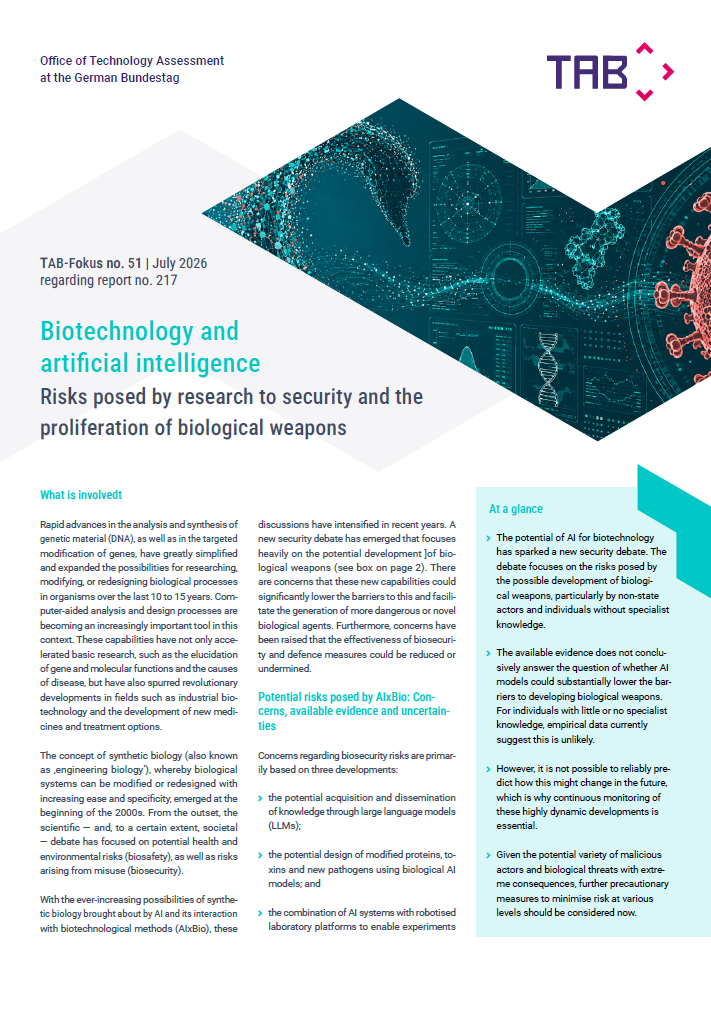
Artificial intelligence opens up new possibilities for biotechnology in research, medicine, and industrial applications. At the same time, there is growing international debate about whether he convergence of AI and modern biotechnological methods could pose biosecurity risks and facilitate the development of biological weapons. The recently published TAB report no. 217, 'Biotechnology and artificial intelligence: Risks posed by research to security and biological weapons proliferation', analyses the current state of the scientific debate, assesses the available empirical evidence, and discusses policy and regulatory options.
Three developments in particular are at the centre of the international security debate: the potential dissemination of knowledge through large language models; using biological AI models to design proteins or pathogens; and increasing automation in biological research through robotised laboratory systems. However, an evaluation of the available studies shows that the question of whether AI significantly lowers the barriers to producing biological weapons remains unanswered. Based on current knowledge, this appears particularly unlikely for individuals without relevant specialist and laboratory experience.
Nevertheless, the report highlights significant uncertainties regarding future developments. In view of possible biological threats with potentially serious consequences, the TAB recommends the continuous monitoring of highly dynamic developments at the intersection of AI and biotechnology. The report also discusses various other precautionary measures designed to both reduce risks and strengthen societal resilience against potential biological threats. These include mandatory safety checks for orders of synthetically produced gene sequences (nucleic acid syntheses), access controls for particularly powerful biological AI models graded according to risk potential, strengthening international control mechanisms and expanding capabilities for pandemic preparedness and biological hazard response.
The project's findings were discussed on 8 July 2026 during a public expert hearing attended by members of the German Bundestag, as well as experts from academia and the professional community. Documentation of the event is available on the TAB website.
In addition to the detailed TAB Report no. 217 (available in German only), the key findings are available in English in TAB Fokus no. 51. Further information can be found on the ‘AIxBio’ project page.
13.08.2026
Downloads and further information
- TAB-Fokus no. 51
Biotechnology and artificial intelligence: Risks posed by research to security and biological weapons proliferation. TAB-Fokus (PDF)
doi.10.5445/IR/1000196057 - TAB-Arbeitsbericht Nr. 217
Biotechnologie und künstliche Intelligenz: Risiken der Forschung für die Sicherheit sowie die Proliferation von Biowaffen (PDF)
doi:10.5445/IR/1000195981 - Documentation of the expert hearing from 8 Juliy 2026
- Project page „AIxBio“ (with TAB-Fokus no. 51, web version)