
Sustainable and safe concepts for climate-friendly shipping
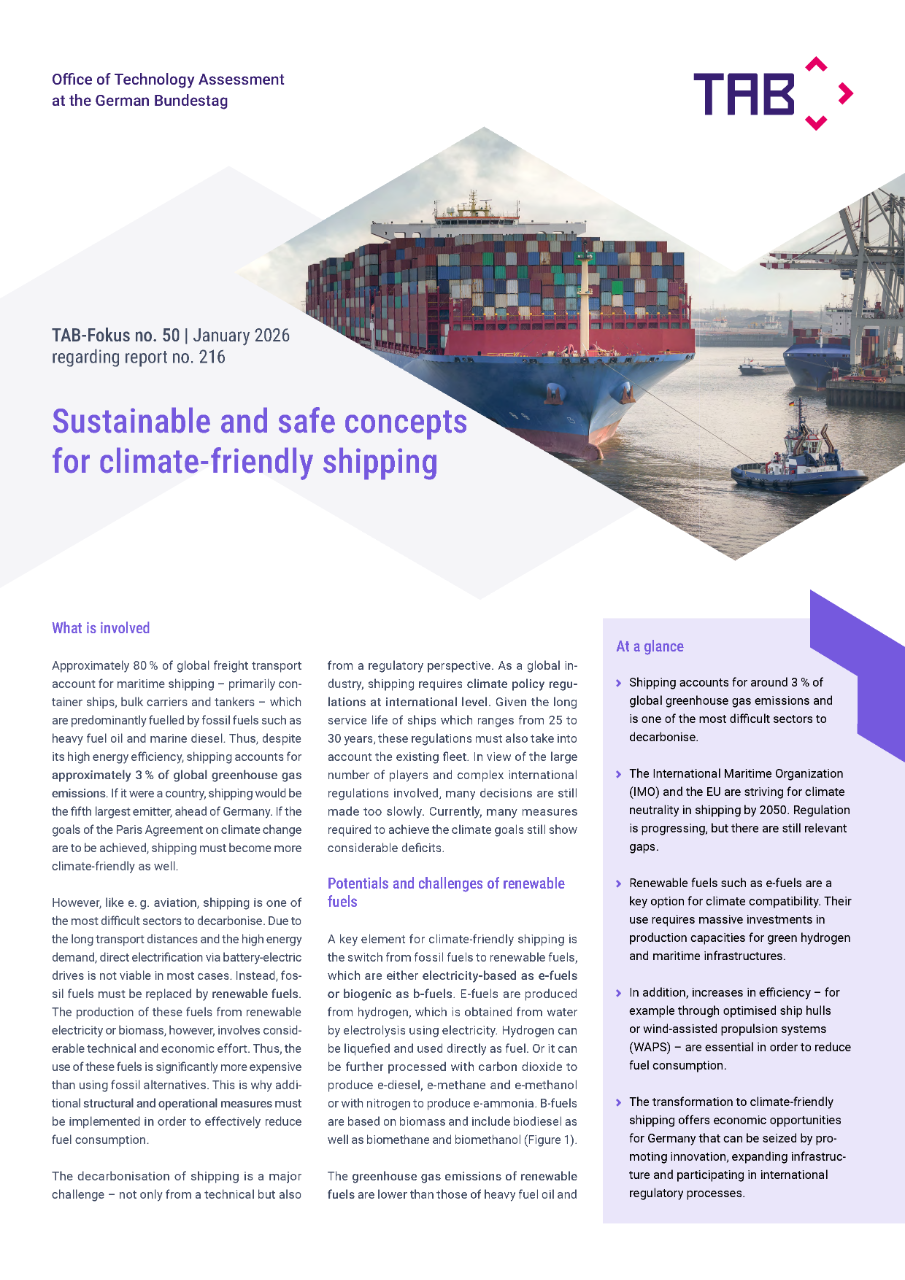
Maritime shipping accounts for around 3% of global greenhouse gas emissions and approximately 80% of global freight transport. International and European climate targets, particularly within the framework of the International Maritime Organization (IMO) and the European Union, aim to make the sector largely climate-neutral by 2050. Decarbonising shipping is a global challenge in which Germany can play a significant role given its status as an export-oriented trading nation with one of the world's largest fleets and as a leading location for shipbuilding and the maritime supply industry. Against this background, TAB Working Report No. 216 analyses key technological, infrastructural and regulatory options for action, as well as their prerequisites and limitations.
Renewable fuels are a central building block
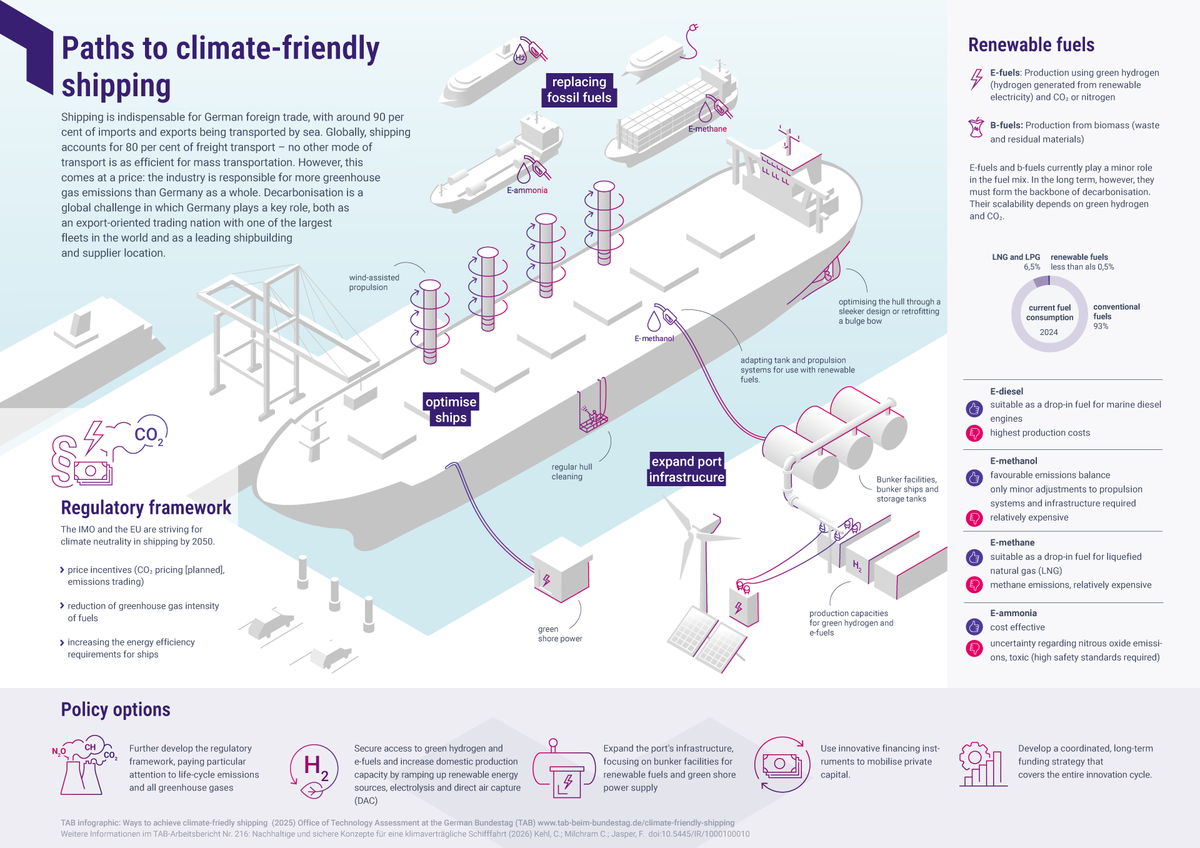
A key component of climate-friendly shipping is switching from fossil fuels to renewable fuels. These include synthetic fuels based on green hydrogen (E-fuels), as well as biogenic fuels derived from waste and residual materials (B-fuels). The report emphasises that the current limited production capacities for green hydrogen and CO2 capture require a significant expansion of renewable electricity generation and the development of the necessary production infrastructure.
Efficiency is key to saving fuel
In some cases, improving the efficiency of ship operation and design can significantly reduce the demand for renewable fuels. This includes optimised hull shapes for new builds, auxiliary wind drives that can be retrofitted, and operational measures such as reducing speed and improving the cleaning of the hull and propeller. The feasibility of these measures and the achievable savings vary considerably depending on the type of ship and operational conditions. The report also highlights potential conflicts of interest with regard to transport capacities and economic conditions, for instance.
Infrastructure for the energy transition in ports
Bunker facilities and suitable handling capacities for renewable fuels are required, and ships moored in the port must be supplied with green shore power. The study emphasises the importance of a reliable supply of green hydrogen and synthetic fuels, and discusses options for strengthening security of supply.
Political guardrails for climate-neutral shipping
The feasibility of technological options largely depends on the regulatory and economic framework. Currently, there are still a number of gaps in the international regulatory framework. Instruments such as CO2 pricing, the European Emissions Trading Scheme and regulations on the greenhouse gas intensity of marine fuels are key levers for creating investment incentives for climate-friendly technologies. Financing and funding instruments also play an important role in the transformation process.
|
TAB Working Report No. 216 emphasises that transforming the maritime shipping sector requires the coordinated efforts of various stakeholders, such as ship operators, fuel manufacturers, port operators, shipyards, suppliers, investors, and regulatory authorities. The long-term climate targets for the shipping sector can only be achieved through the parallel development of renewable fuels, shipbuilding and operational efficiency measures, as well as the construction of suitable infrastructure. This must be accompanied by the further refinement of the international and European regulatory framework.
The most important findings are summarised in TAB Fokus no. 50 and on the project page. The infographic 'Paths to climate-friendly shipping' provides a clear visualisation. |
05.02.2026 / 13.02.2026
Downloads and further information
- TAB-Fokus no. 50
Sustainable and safe concepts for climate-friendly shipping (PDF)
doi: 10.5445/IR/1000190013 - TAB-Arbeitsbericht Nr. 216
Nachhaltige und sichere Konzepte für eine klimaverträgliche Schifffahrt (PDF)
doi: 10.5445/IR/1000190010 - TAB infographics: Paths to climate-friendly shipping (PDF)
- Project page (with TAB-Fokus no. 50 web version)